MiMo-V2.6: Scaling Up Reinforcement Learning for Self-Improvement
Today, we are officially releasing and open-sourcing the Xiaomi MiMo-V2.6 series. This marks a key step in our exploration of the RSI (recursive self-improvement) path: building on verifiable complex tasks, we scale up reinforcement learning (RL) computing power to enable models to continuously expand the boundaries of intelligence through ongoing exploration and feedback.
Where the path is flat and close, travelers are many; where it is rugged and distant, few reach the end. In an era where intelligence can be easily replicated, we choose to channel computing power into real-world environments, letting models learn through trial and error in iterative feedback loops. This path is slower, and far less visible. The 6 days of Live RL training for MiMo-V2.6 mark a public trek we’ve taken along this road; behind these 6 days lie half a year of foundational research accumulation and engineering trial and error.
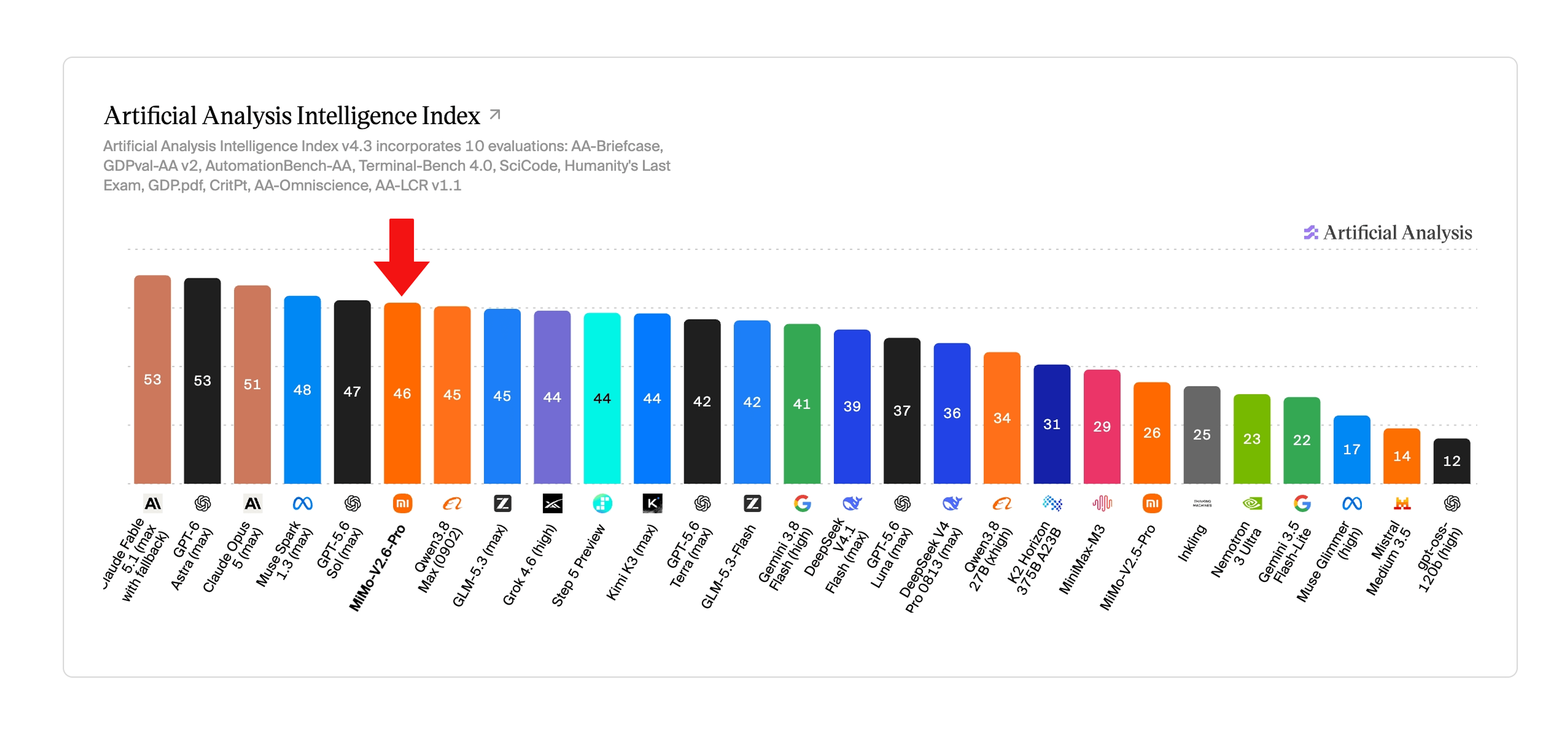
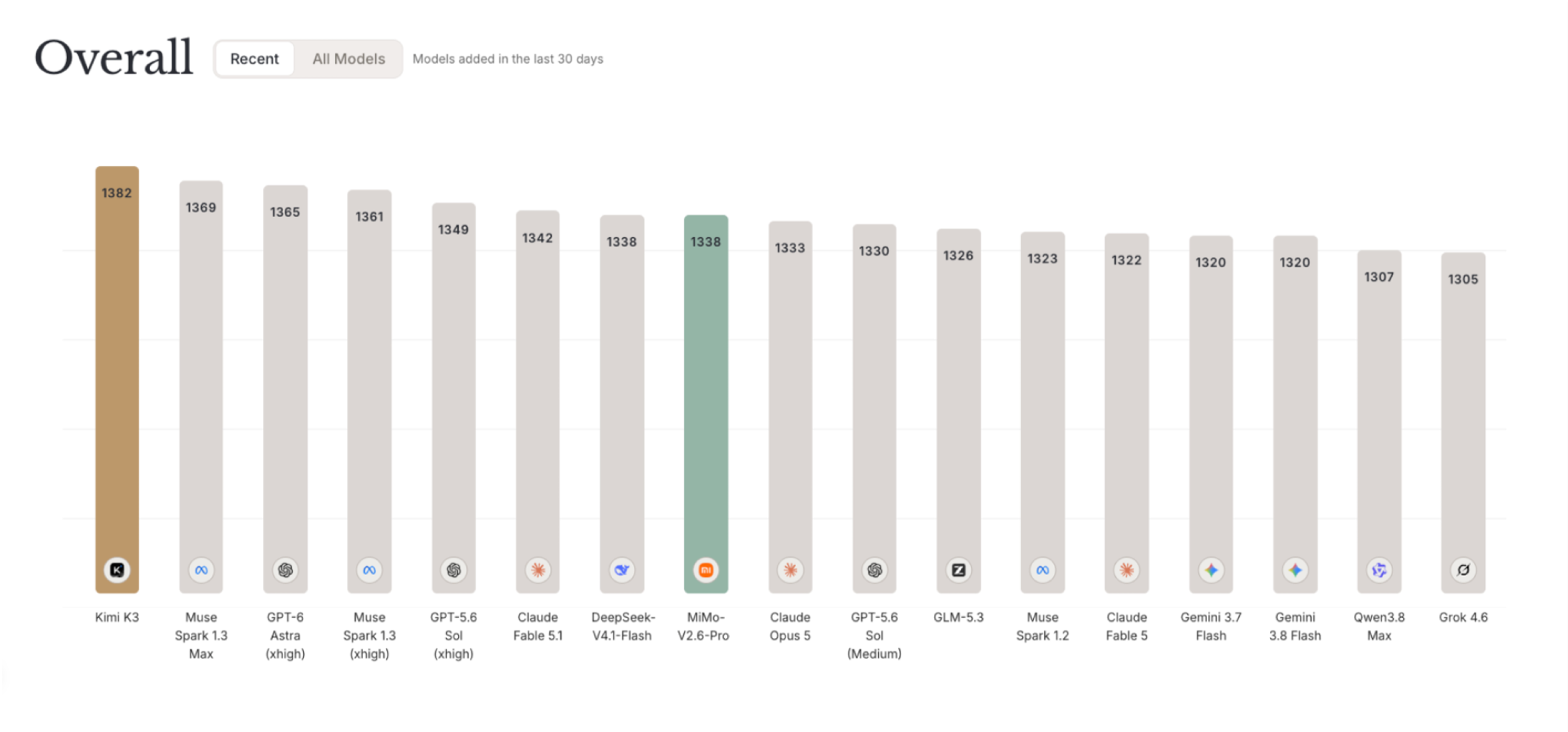
The MiMo-V2.6 series comprises two native fully multimodal models, namely Pro and Flash. Benefiting from the expanded RL computing power, MiMo-V2.6-Pro scores 46 points in the Artificial Analysis Intelligence Index (AA Composite Intelligence Index), surpassing Kimi K3 and Qwen3.8 Max to become the most powerful open-source model available;However, there is still a gap when compared with the strongest closed-source models Claude Fable 5.1 and GPT-6 Astra.
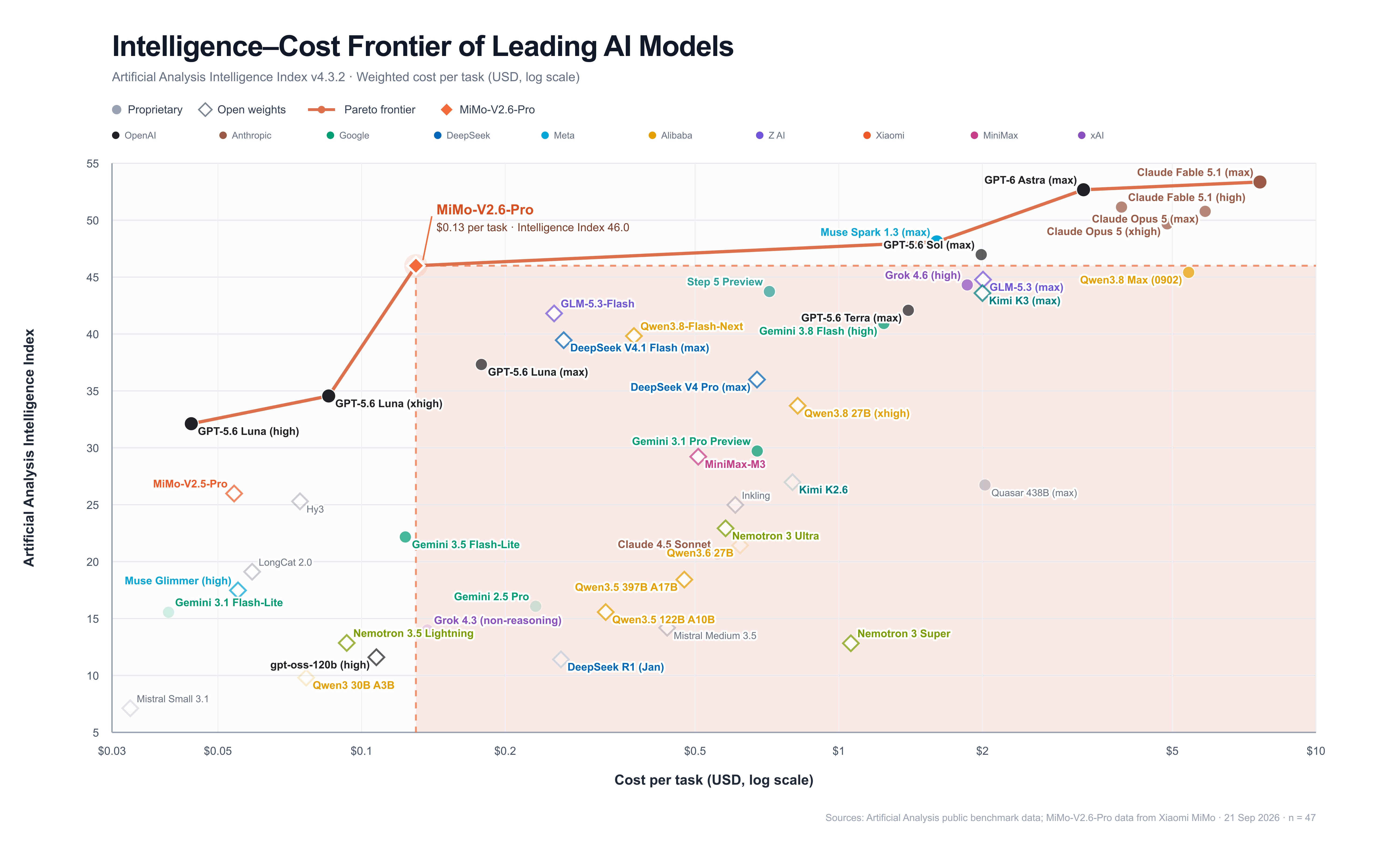
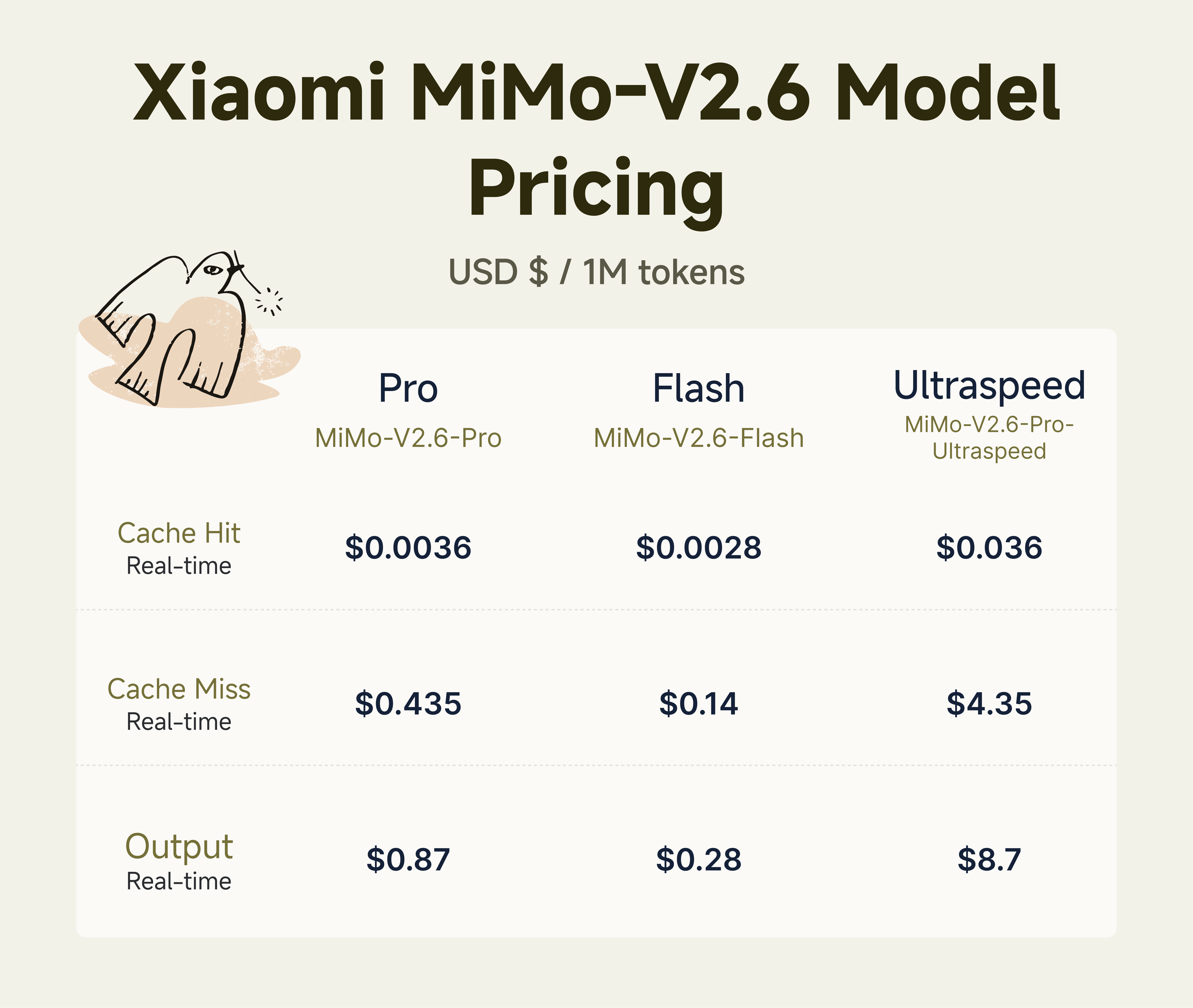
The MiMo-V2.6 series adopts the same API pricing as the V2.5 series. With intelligent performance upgraded while price remains unchanged, the Pareto frontier of "intelligence vs. cost" has thus been pushed outward once again. The MiMo-V2.6-Pro has set a new cost-performance record for domestic large language models: at the same intelligence level, its price is only 1/20 to 1/60 that of overseas models.
Scale RL on a large scale and fully open-source it
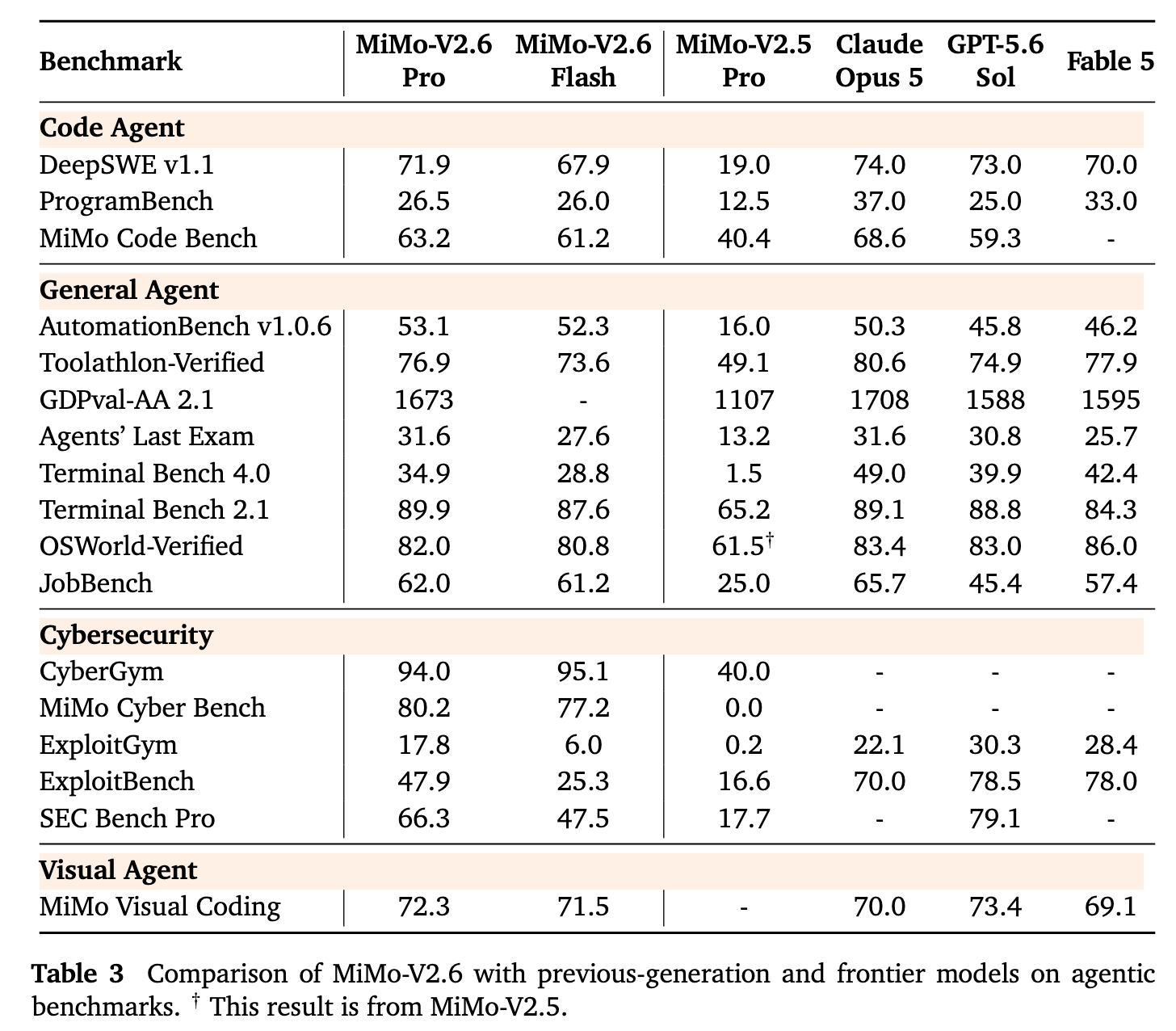
During the RL training phase, MiMo-V2.6 is likely one of the domestic open-source models that has been allocated the largest amount of computing power to date. After large-scale, multi-task reinforcement learning training, MiMo-V2.6-Pro has achieved performance on most Agent Benchmarks that is on par with Claude Opus5 and GPT-5.6 Sol, while MiMo-V2.6-Flash has comprehensively outperformed MiMo-V2.5-Pro**.**
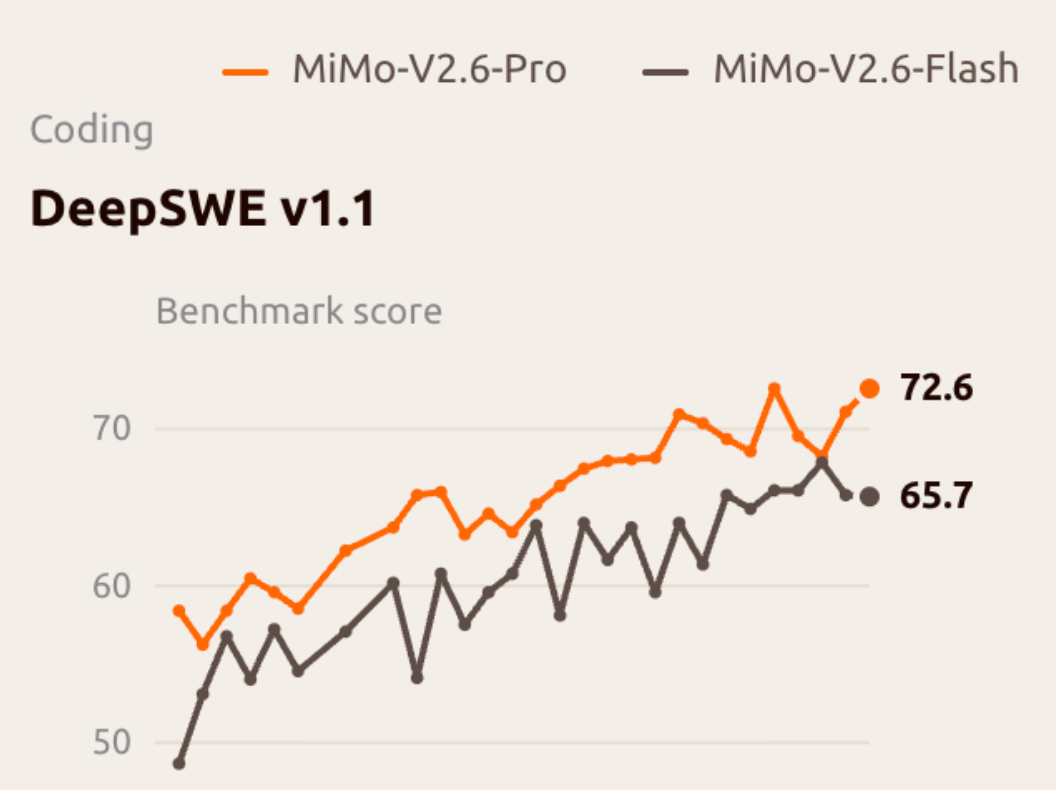
Throughout the entire process, we overcame fundamental research and engineering challenges in RL training, and documented the official experimental journey via live sharing. In less than 6 days, MiMo-V2.6-Flash and MiMo-V2.6-Pro completed 30 steps each with a cumulative total of approximately 750,000 trajectories, at training costs of around 850,000 and 2.62 million US dollars respectively;The average pass rate of training tasks has been relatively improved by 25% and 12% respectively, and the out-of-sample long-range software engineering evaluation benchmark DeepSWE v1.1 has been improved by approximately 17 points (from 48.8 to 65.7) and approximately 14 points (from 58.4 to 72.6) respectively, which reflects the high sample efficiency, continuous improvement capability and out-of-sample generalization capability of RL.
This training mainly expands RL computing power from three dimensions:
-
Larger Batch Size and Higher Throughput: By combining a large batch size and a fully asynchronous architecture, each update uses 1,568 samples, supports training with 1M context length, and the number of tokens per training step reaches 3.5~3.7B.
-
More Tasks and Complex Environments: Build a multi-task training system covering fields such as Code, General, Visual, and Cyber, and integrate multiple Harnesses to facilitate the collaborative improvement of different capability dimensions.
-
Greater Grader computing power: through relative comparison within the Group, it provides more accurate and diverse reward signals for Long-Horizon RL tasks, forms a closed loop for model self-improvement, and guides the model to complete tasks with shorter paths and fewer Tokens.
As the training scale expands, we freeze the MoE Router to suppress expert load drift, and establish a defense against Reward Hacking that covers reward design, adversarial evaluation, anomaly detection and cross-verification of validators, so as to improve training stability and reward reliability.
To support multi-agent reinforcement learning for large-scale hybrid tasks, we have designed a unified trajectory representation and penalty mechanism to refine learning signals, support high-concurrency interactions of various multi-agent frameworks, decouple the control plane and data plane to enable the migration of massive trajectories, stabilize the sample ratio of each task in hybrid batches, and optimize the efficiency of training and inference engines as well as their consistency.
We have open-sourced the aforementioned technical achievements and supporting resources, including the complete technical report, training environment and RL code, to help more researchers reproduce and verify relevant results, and jointly explore more possibilities of large-scale RL and model self-improvement.
From Vibe Coding to Vibe World
MiMo-V2.6 integrates 3D spatial reasoning, multimodal perception and computer user operation (CUA) capabilities, further expanding the boundaries of what programming can achieve; it can extend natural language-driven programming tasks into the "Vibe World" oriented towards interactive world construction.
3D open-world game
In game development, after a user inputs images, videos, or text, MiMo-V2.6 breaks down the requirements into multiple tasks, which are completed through multi-agent collaboration: 3D game scene construction, interactive logic programming, and visual verification. It then makes continuous corrections based on the rendering results, and ultimately generates a runnable interactive world that aligns with the user's intent.
Blender 3D Modeling
MiMo-V2.6 can complete 3D modeling of objects and scenes in Blender based on users' text descriptions or reference images, and generate 3D assets that can be used for animation production, 3D printing and game development.
Embodied Intelligence
In the embodied simulation environment, MiMo-V2.6 can directly take multi-view camera images as input, continuously perform inference and decision-making, and control the Franka Panda robotic arm through a visual feedback closed loop to complete object grasping, color matching and precise placement.
Computer Use Agent
MiMo-V2.6 further expands the Computer Use capability by integrating multimodal perception with natively trained action capabilities. It is capable of understanding complex graphical user interfaces, utilizing common office and productivity tools to accomplish tasks such as information retrieval, editing and data processing, as well as checking results, troubleshooting issues and adjusting subsequent actions based on visual feedback.
Advance cutting-edge scientific research
Without undergoing specialized reinforcement learning tailored for scientific research tasks, MiMo-V2.6 has already demonstrated application potential across multiple research domains. From materials design to mathematical formalization, the following cases illustrate how the model applies its capabilities in reasoning, programming, and tool utilization to specific scientific research tasks.
Co-Scientist in Materials Research
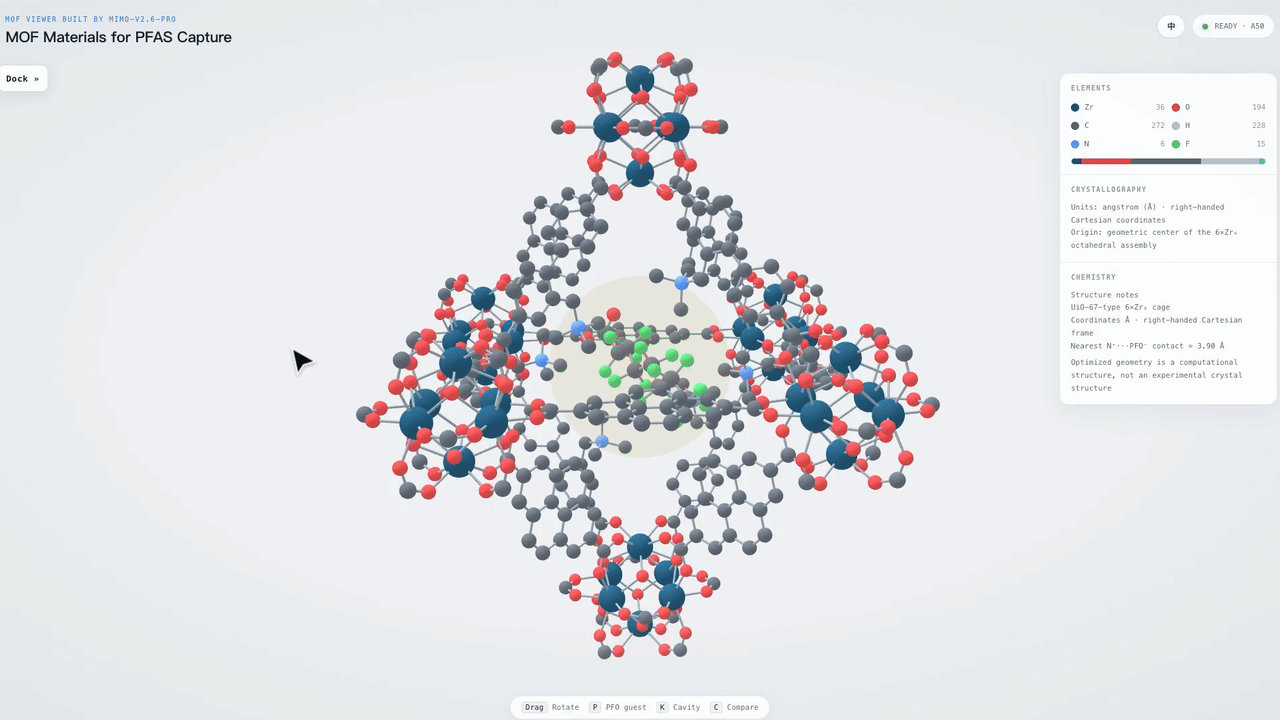
MiMo-V2.6-Pro assists researchers in completing material design and computational screening. Under multiple rounds of prompts and interactions from Xiaomi's cutting-edge materials research team, it has proposed several design schemes for metal-organic framework (MOF) materials, targeting the adsorption of per- and polyfluoroalkyl substances (PFAS), which are known as "persistent pollutants". During this process, the model retrieves and sorts relevant literature and patents, puts forward research hypotheses, and evaluates the novelty of the design schemes.
Subsequently, it further carried out "dry experiments": that is, calling open-source computing tools to automatically build a simulation environment, calculating the binding strength between the designed MOF materials and PFAS, and screening out the most promising candidate materials for subsequent verification through "wet experiments".
Formal Mathematical Proof
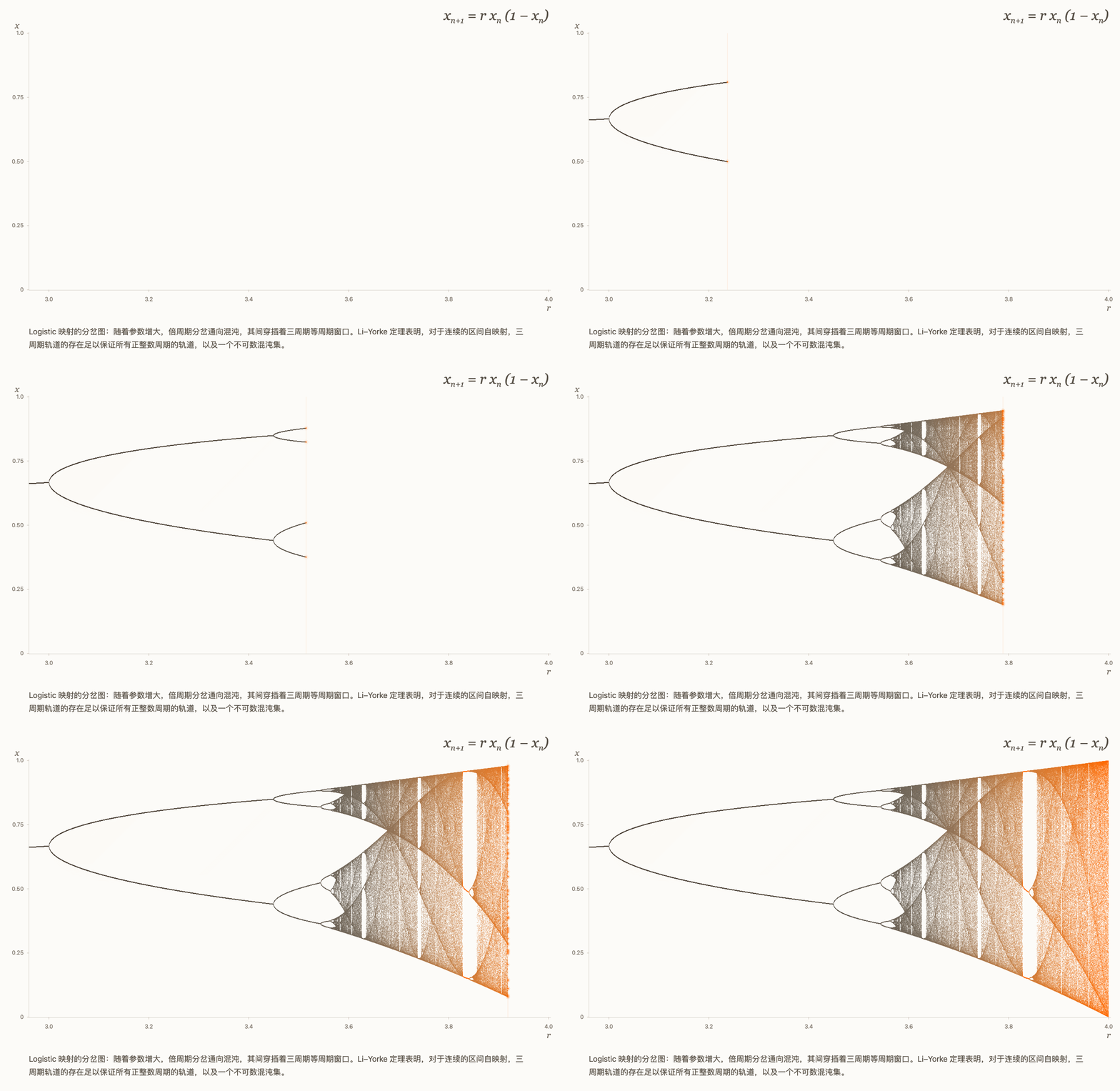
MiMo-V2.6-Pro assists researchers in completing the full formalization of the main theorem in Li and Yorke's classic paper Period Three Implies Chaos within Lean 4. This theorem reveals that for a continuous self-mapping on an interval, the existence of a period-3 orbit is sufficient to entail orbits of all positive integer periods as well as an uncountable chaotic set.
Guided by the exploration strategy designed by the researchers, MiMo-V2.6-Pro advances the formalization of theorem statements and proofs through Sub-Agent collaboration. After subsequent revision and integration, the project finally yields over 6,000 lines of Lean source code, whose complete proof has been verified by the Lean kernel with no unproven placeholders left. As the model has not undergone specialized post-training for Lean, this case demonstrates its capability to participate in complex formal proof tasks.
Code-Driven Content Creation and Aesthetic Expression
The MiMo-V2.6 series has significantly enhanced the model's capability to create exquisite digital products, covering a wide range of fields including front-end web pages, Figma design drafts, slideshows, SVG, videos, music and more. On the design evaluation leaderboard Design Arena, MiMo-V2.6-Pro has achieved a level comparable to that of Claude Opus 5 and GPT-5.6 Sol.
Aesthetic Expression of Front-end & PPT
MiMo-V2.6 can convert simple instructions into complete front-end interfaces and PPTs, generate structured layouts, and elaborate well-designed components, interactive elements and rich animation effects. It is also proficient in using Figma and image/video generation tools to produce visual creatives that match the overall style, maintain consistency in fonts, color schemes and graphic-text arrangement, and balance aesthetic expression with reading and interactive experience.
Video Creation
MiMo-V2.6 is capable of end-to-end high-quality video creation. In creative and product Promotion Video scenarios, MiMo-V2.6 can complete visual design, shot and motion effect arrangement, soundtrack synthesis and rhythm alignment according to user requirements;In popular science videos, it can translate abstract concepts such as Fourier Decomposition and Convex Hull into easy-to-understand explanations and coherent animations, and invoke MiMo-V2.5-TTS to synthesize voiceovers that are precisely aligned with the visuals, thereby turning complex knowledge into vivid content that audiences can readily comprehend, and realizing full-process automation from concept decomposition to final video output.
Music Creation
In MiMo-V2.6, we have further enhanced the model's capabilities in music understanding, aesthetic judgment and knowledge application, and explored its application in music creation. It has demonstrated the ability to create Demo-level music works, as well as the potential to assist professional composers and arrangers in their creative work.
In this case, MiMo-V2.6-Pro created a piece as required which is an orchestral work featuring around ten instruments. After generating the musical score, it autonomously converted the work into MIDI format. This piece demonstrates the model's understanding of the division of labor and orchestration relationships among different instruments, as well as its capability to apply musical knowledge to melody creation and overall arrangement.
Get started
Use Xiaomi MiMo Desktop Client
With the release of the new models, the MiMo Desktop Client and membership subscription plan have been launched simultaneously. You are welcome to download and experience them via the link below. Subscribing to the membership grants access to the MiMo-V2.6-Pro and Flash models, and you can also configure your own API Key to use the Client.
🔗: https://mimo.xiaomimimo.com/desktop/
MiMo Desktop is launched with the UltraSpeed mode of MiMo-V2.6-Pro synchronously, delivering up to 20x inference speed to support scenarios requiring highly real-time interaction and sensitive response latency.
The original invitation-only beta program will end in one week. Users who have already obtained the beta qualification can continue to use it after switching the model name.
Access the Xiaomi MiMo API
Meanwhile, the MiMo-V2.6 series has been launched on the Xiaomi MiMo Open Platform, and the API prices remain unchanged.
MiMo-V2.6-Pro also provides the UltraSpeed ultra-high-speed mode on the Open Platform, delivering up to 20x inference speed.
The pricing of the model is as follows:
Fully open source
We have fully open-sourced the weights and technical report of the MiMo-V2.6-Pro and Flash models, simultaneously released the MiMo-V2.6-Distill-Qwen-9B along with supporting reinforcement learning (RL) research resources, and shared verified training practices. The detailed open-source contents are as follows:
-
7k+ high-quality RL task environments: covering four types of agent tasks: software engineering, vulnerability reproduction, knowledge-intensive work, and web design and development.Starting RL training from MiMo-V2.6-Distill-Qwen-9B, improvements over the SFT baseline were achieved across all 11 benchmarks: SWE-bench Verified increased from 61.1 to 66.2, MiMo Cyber Bench from 31.3 to 47.0, Terminal Bench 2.1 from 37.1 to 52.8, and MiMo Visual Coding from 64.0 to 72.4;
-
End-to-end RL training framework: Built on verl, uni-agent and mini-swe-agent, it covers the full training pipeline including environment interaction, trajectory collection, reward evaluation and policy optimization. With support for open models and task environments, it enables the community to conduct research and iteration on training algorithms, reward mechanisms and agent harness.
-
Lightweight and Composable Harness: Open-source minimalist mini-harnesses decouple system prompts, tools and context management to construct diverse and controllable training configurations. Through Multi-Harness Training, diversity and neatness can be integrated into RL training, improving the model's generalization ability across different frameworks, including unseen ones, while supporting the community to freely combine framework components, expand training configurations, and continuously explore new research directions.
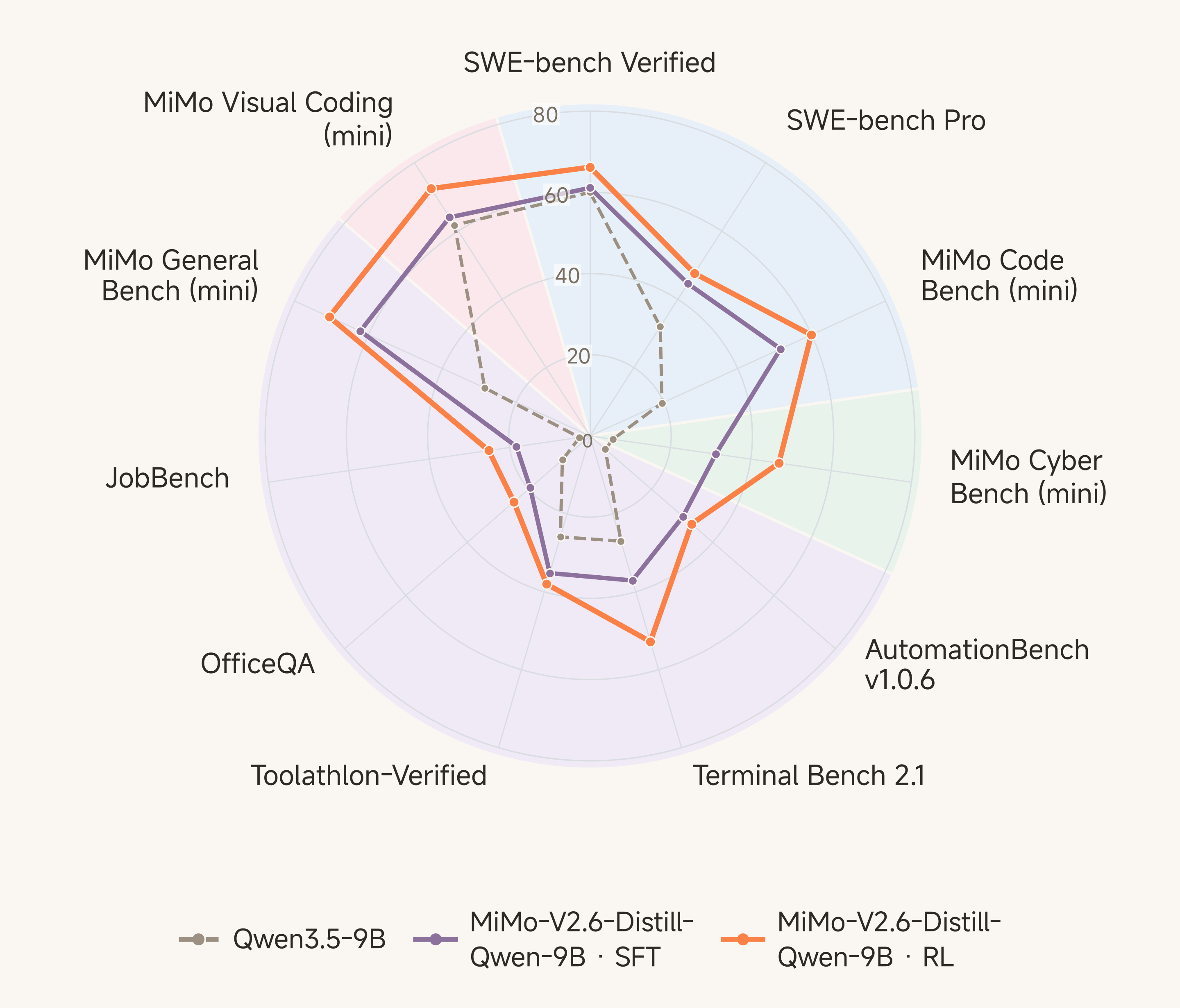
It is hoped that this sharing will provide a common foundation for the community to continuously explore reinforcement learning algorithms and agent mechanisms, and promote the continuous advancement of Agentic RL research.
Open Source Link: https://huggingface.co/collections/XiaomiMiMo/mimo-v26
Note: When calling the API, please use the all-lowercase model names mimo-v2.6-pro, mimo-v2.6-flash, and mimo-v2.6-pro-ultraspeed.